

Why Pad Printing is Ideal for Medical Devices
Comments Off on Why Pad Printing is Ideal for Medical DevicesWhy Pad Printing is Ideal for Medical Devices
Medical devices rely on clear, accurate markings to support identification, branding, and everyday use. Whether the product is a handheld diagnostic device, surgical instrument, or disposable component, printed graphics must remain readable and consistent throughout production. Pad printing has become a preferred solution because it delivers precise results on parts with curves, recessed areas, and other challenging surfaces. For manufacturers looking for dependable medical product pad printing, this process offers the accuracy and repeatability needed for demanding applications while supporting high production standards.
Medical Devices Require Precise and Durable Identification
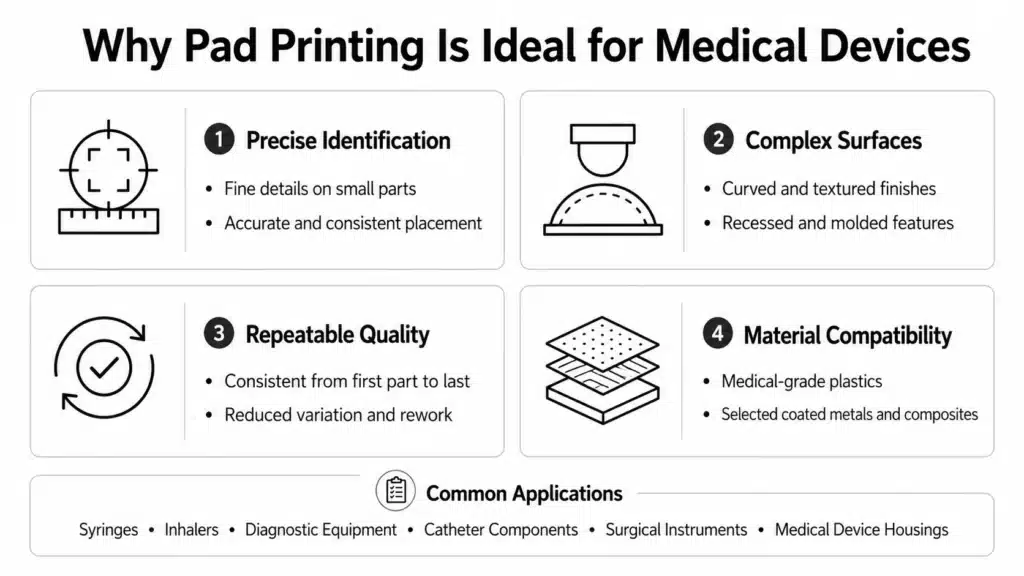
Every medical device carries important information that must remain legible from production through end use. Logos, measurement scales, warning symbols, serial numbers, and product identification all play a role in helping users operate devices correctly and helping manufacturers maintain traceability.
Reliable medical product pad printing gives manufacturers the ability to place fine details exactly where they belong, even on small parts. Consistent print placement also helps maintain quality throughout production runs, reducing variation between components. A dependable printing process supports both product appearance and manufacturing efficiency, helping your finished products meet customer expectations with every order.
Pad Printing Works on Complex Medical Components
Medical products rarely have perfectly flat surfaces. Many include molded shapes, textured finishes, recessed features, or small areas that are difficult to decorate with conventional printing methods. Pad printing solves this challenge by using a flexible silicone pad that transfers graphics accurately onto irregular surfaces.
This process works well for products such as:
- Syringes, inhalers, diagnostic equipment, catheter components, surgical instruments, and medical device housings with curved or textured surfaces.
Many manufacturers also rely on medical plastic housing pad printing because plastic enclosures often require branding, operating instructions, or safety markings without affecting the part itself. Pad printing delivers crisp graphics on these molded housings while maintaining consistent placement from one component to the next.
High-Quality Printing Supports Medical Manufacturing Standards
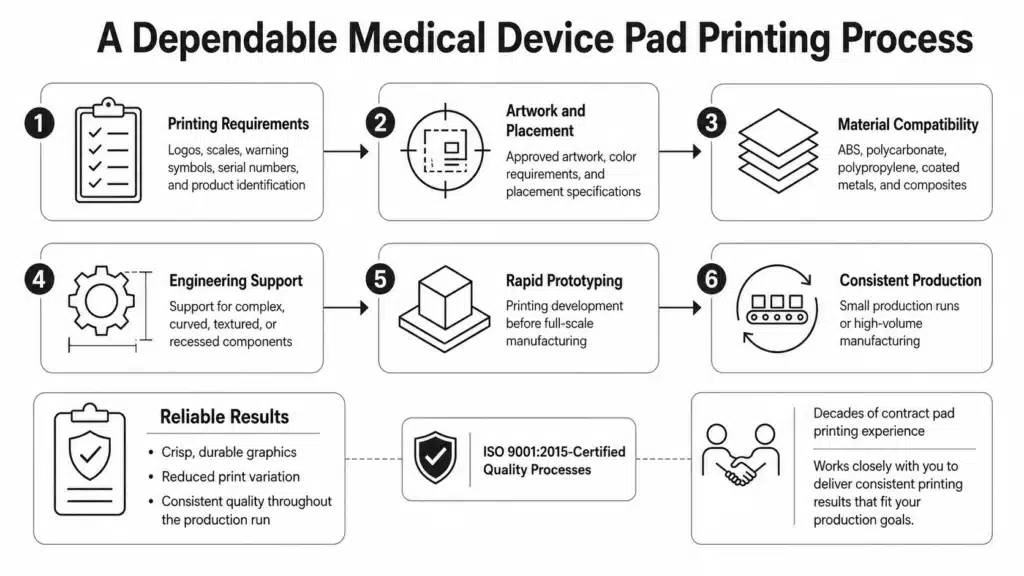
Consistency is a priority in medical manufacturing. Every printed component should match approved artwork, color requirements, and placement specifications throughout the production run.
Pad printing provides repeatable results that support these expectations. Fine text, detailed graphics, and multi-color images can be reproduced with a high level of accuracy, helping manufacturers maintain a professional appearance across their product lines. Reliable medical product pad printing also supports quality control by reducing print variation and minimizing the need for rework. Working with an experienced contract printer gives manufacturers confidence that every production run will meet the same performance standards from the first part to the last.
Pad Printing is Compatible with Common Medical Materials
Medical devices are produced from a wide variety of materials, many of which require dependable ink adhesion for long-lasting results. Pad printing is commonly used on medical-grade plastics such as ABS, polycarbonate, and polypropylene, along with selected coated metals and composite materials.
For manufacturers requiring medical plastic housing pad printing, compatibility with these materials is a major advantage. Clear, durable graphics can be applied without compromising the appearance of the finished product, helping support product identification and brand recognition throughout its service life.
Choosing an Experienced Pad Printing Partner
Selecting the right printing partner can make production more efficient from prototype through full-scale manufacturing. Pad Printing Technology, Inc. combines decades of contract pad printing experience with engineering support, rapid prototyping, and ISO 9001:2015-certified quality processes. Whether your project involves a small production run or high-volume manufacturing, the company works closely with you to deliver consistent printing results that fit your production goals.
Get consistent, high-quality results for your next medical device project by partnering with Pad Printing Technology, Inc. for reliable pad printing solutions.
Applications of Medical Device Pad Printing
Comments Off on Applications of Medical Device Pad PrintingApplications of Medical Device Pad Printing
Medical device manufacturing requires marking methods that deliver clarity, repeatability, and long-term readability across a wide range of materials and part geometries. One widely used approach is medical device pad printing, a process that transfers fine detail onto both flat and curved surfaces using a silicone transfer pad and etched plate. It is commonly selected for components where laser or direct printing methods fall short, particularly on small parts or irregular shapes.
Across production lines, medical pad printing is applied to add identification marks, symbols, measurement indicators, and branding on devices that must remain legible through handling, cleaning cycles, and sterilization processes. The process supports consistent marking across plastics, metals, and coated substrates used in healthcare manufacturing.
Surgical Instruments and Precision Tools
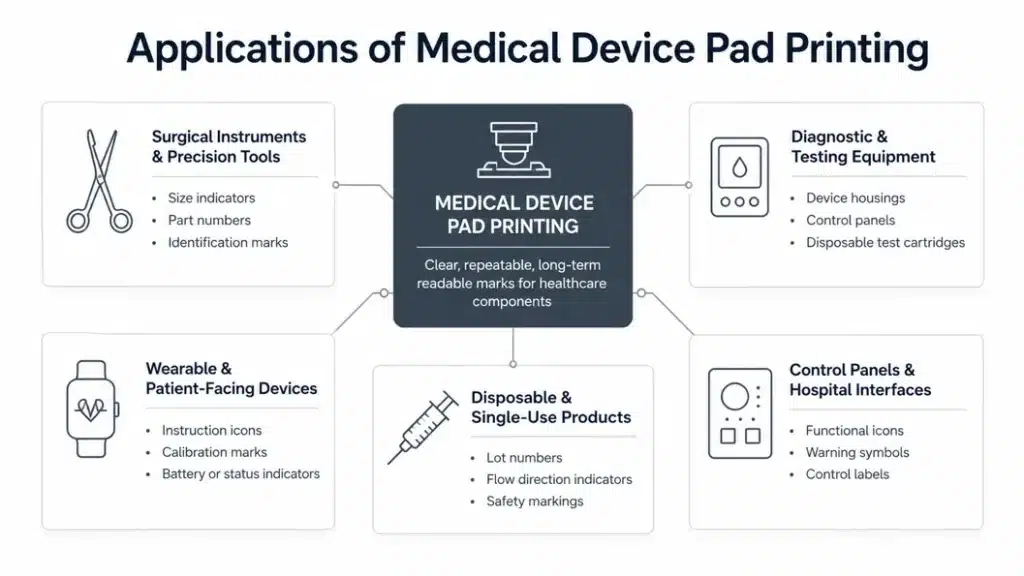
Surgical tools rely heavily on pad printing medical devices for clear size indicators, part numbers, and identification marks. Forceps, clamps, retractors, and scalpels often require markings that stay readable after repeated sterilization cycles. Pad printing allows direct application onto curved metal surfaces without distorting fine details.
Manufacturers typically use this process for:
- Instrument sizing marks
- Lot and batch identification
- Brand or facility codes
This helps production teams standardize instrument sets and supports hospital tracking systems.
Diagnostic and Testing Equipment Components
Diagnostic devices depend on precise user-facing indicators. Medical device pad printing is commonly used on housings, control panels, and disposable test cartridges. The process supports fine line graphics that remain readable under frequent handling.
Typical applications include:
- Glucose monitoring devices
- Blood test cartridges
- Imaging equipment control buttons
Pad printing allows multi-color markings where different symbols and labels guide user operation without cluttering the surface design.
Wearable and Patient-Facing Devices
Wearable devices require markings that are both durable and discreet. Medical pad printing is used on insulin pumps, heart monitors, and sensor-based patches where space is limited and readability is critical.
Common uses:
- Instruction icons on device housings
- Calibration marks
- Battery or status indicators
These markings remain stable even when exposed to sweat, skin contact, and routine cleaning.
Disposable and Single-Use Medical Products
Disposable medical components depend on fast, repeatable marking during high-volume production. Pad printing supports production of items such as catheters, tubing connectors, and syringes.
Key uses include:
- Lot numbers for traceability
- Flow direction indicators
- Safety markings
Because pad printing can work on medical-grade plastics, it fits well into large-scale disposable manufacturing lines.
Control Panels and Hospital Equipment Interfaces
Hospital equipment interfaces require clear labeling that supports quick recognition. Pad printing medical devices is used on knobs, buttons, and display surrounds for ventilators, monitors, and infusion systems.
Common applications:
- Functional icons
- Warning symbols
- Control labels
The process allows consistent alignment across repeated production runs, supporting standardized equipment layouts.
Materials and Production Considerations
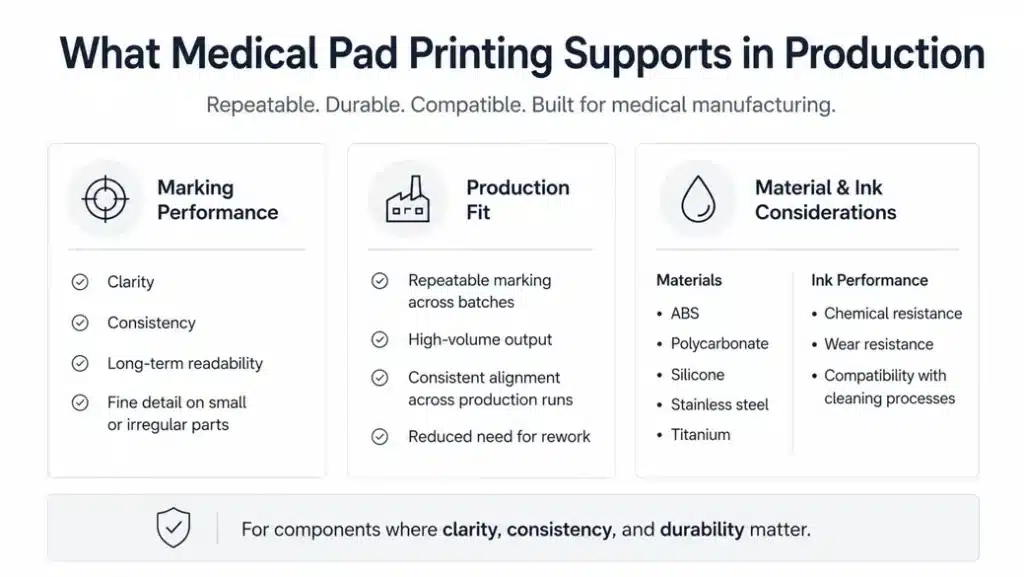
Medical device components often use materials such as ABS, polycarbonate, silicone, stainless steel, and titanium. Pad printing adapts well to these surfaces with proper preparation steps like plasma or flame treatment when required.
Ink selection plays a direct role in performance. Manufacturers typically use inks formulated for:
- Chemical resistance
- Wear resistance
- Compatibility with cleaning processes
This combination supports long production runs without frequent rework.
Practical Value in Medical Manufacturing
Medical pad printing fits production environments where repeatability and surface flexibility matter. It supports high-volume output while maintaining consistent marking quality across batches. For manufacturers, it provides a direct method to apply critical information without redesigning components or altering part geometry.
Marks That Don’t Fade, Print That Doesn’t Miss
Medical devices, industrial parts, and precision components all have one thing in common, they don’t forgive sloppy marking. When clarity, consistency, and durability matter, Pad Printing Technology delivers prints that stay sharp long after production is done.
Ready to put precise marking to work on your parts? Talk to Pad Printing Technology today and get printing that holds its ground, no smudges, no guesswork, no shortcuts.
